
In Gatekept: Why GiveWell’s Highly Educated Workforce (Reasonably?) Won’t Fund Education, I argued that evidence for education’s impact on earnings in LMICs was weak, and hoped new research would help soon. At the time, the best randomized evidence was from a Duflo, Dupas, and Kremer study of secondary school scholarships in Ghana (henceforth DDK), which was noisy and couldn’t separate the effect of learning from the effect of more years in school. We now have an RCT that gets much closer!
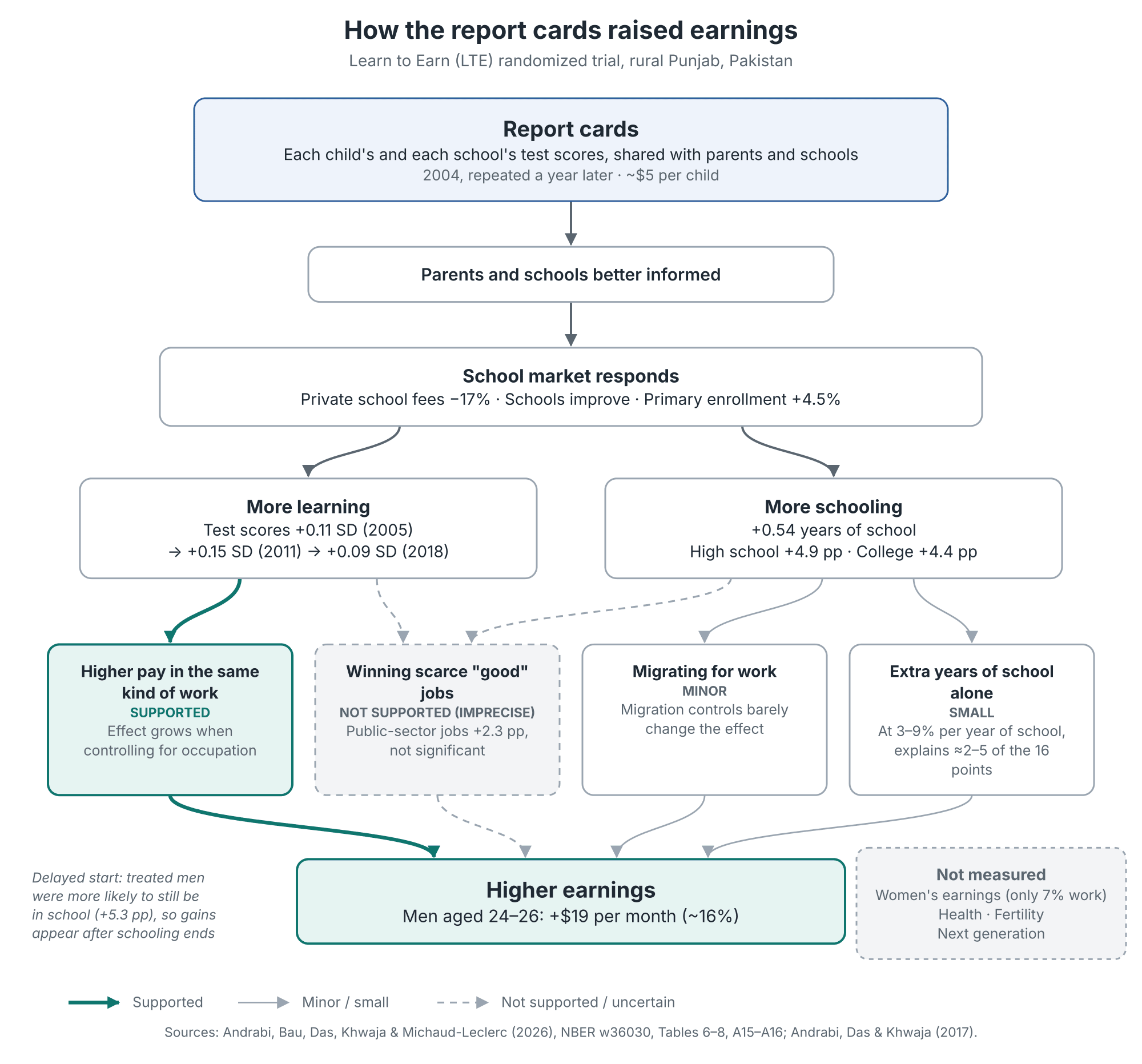
Learn to Earn: The Long-Term Effects of Foundational Learning (henceforth LTE), released as a working paper this month, follows Pakistani children for 15 years, and includes a randomized report card intervention that raised primary school test scores by 0.11 SD. Fifteen years later, men in their mid-20s from treated villages earned about 16% more than those from control villages (95% CI: roughly 1% to 31%).
TLDR: LTE makes it much more credible that improving learning raises adult earnings, though the size of the effect remains very uncertain. Even conservative estimates suggest some education interventions could clear GiveWell's bar, and GiveWell and other EA orgs should reconsider their stances on educational interventions.
The Paper
LTE uses test score and income data in Pakistan to conduct two analyses that follow subjects from early schooling to adulthood. Sadly, only 7% of the women studied are in the labor force as adults, so we’ll focus on male outcomes here.
The stronger of the two analyses looks at the effects of a 2004 randomized village-level trial that gave parents and schools in treated villages student and school-level report cards to inform parents' school choices and give schools feedback on their performance. There were ~ 2,000 students in the trial across 112 villages. The program raised test scores by 0.11 SDs and income (for men in their mid-20s) by 16%.
The other analysis is observational and uses students who switched schools to estimate the effect of attending a better school for ~ 3,000 students (~ 1,200 of whom had followup income data). They argue that these switches are usually due to family convenience (having siblings in the same schools), rather than responses to school quality. They have some evidence for this, but can’t prove it definitively. Attending a school 1 SD higher in SVA (school value added, a measure of how good schools are at raising test scores) raised test scores by ~0.19 SD and men's earnings by 28% (95% CI: ~2% to 62%).
Effect Sizes
What do those income gains translate to in more common terms? About 145% higher earnings per SD of test scores for the RCT and 147% for the switcher design. Always nice to see different designs returning similar answers! DDK’s effect size was also quite large, around 70%.
How big are those effects? The most-cited benchmark is the Mincerian return to schooling: globally, each extra year of school is associated with about 9% higher earnings (Psacharopoulos & Patrinos 2018). That converts to roughly 26% per SD of test scores. GiveWell has been skeptical of estimates like this, partly because they're correlational.
Usually, randomized trials find smaller effects than observational ones, since observational studies tend to pick up things like family advantages. Here it’s the opposite: LTE's RCT estimates are more than five times larger than the Mincerian ones! That’s an interesting finding, but also suggests we may want to apply a sizable discount for potential noise from a single, just below p < 0.05 study.
I built two cost-effectiveness models here, using LTE's income effect. For the report card program itself, I find returns of ~15x cash after discounting LTE's effect for noise, zero-sum effects, and generalizability. For structured pedagogy, I convert LTE's result to earnings per SD of test scores, then apply the same discounts, plus adjustments for how much of LTE's effect came through learning, and for fade-out. That also clears GiveWell's bar, though just barely at 6.5x.
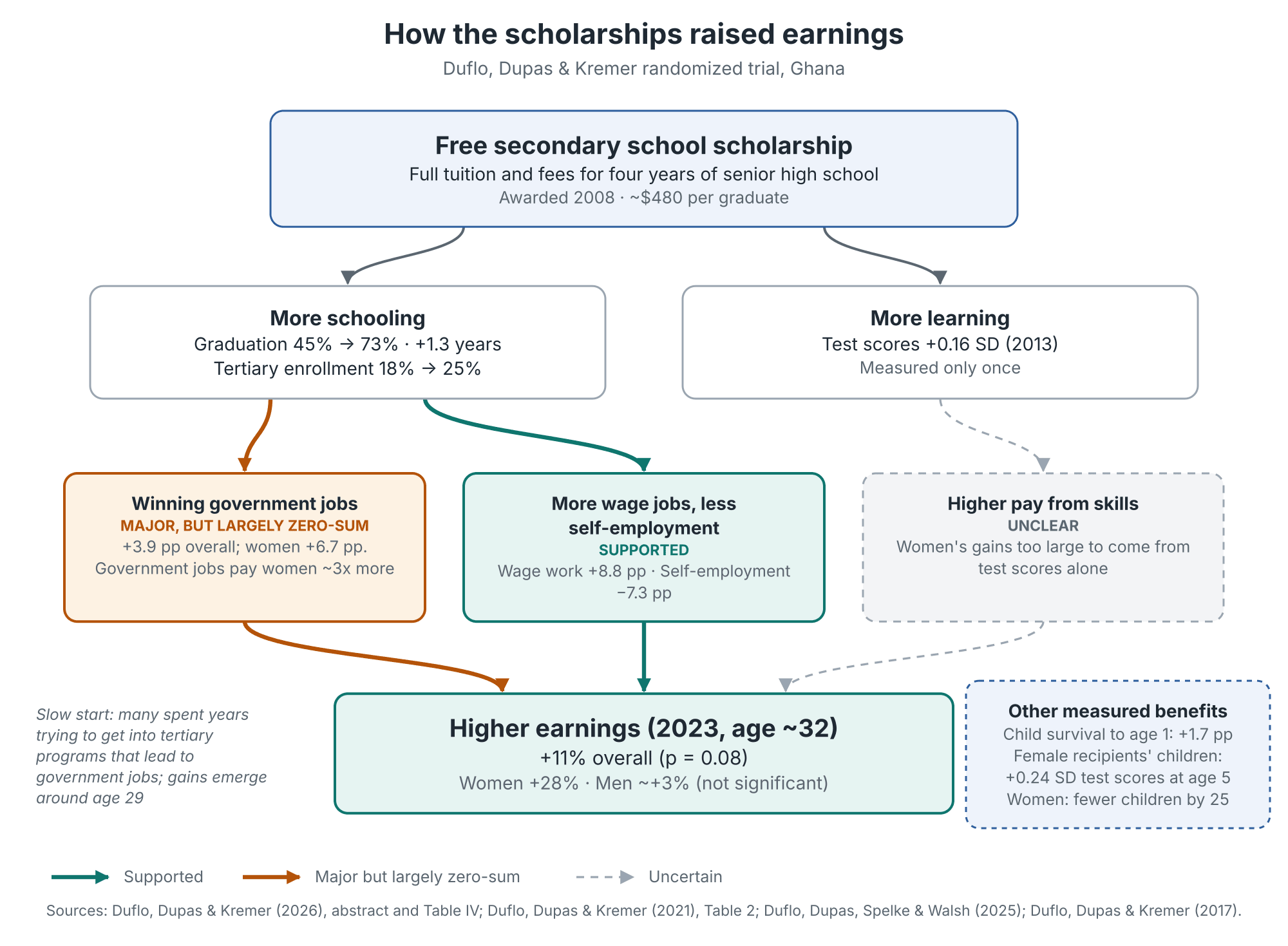
And that’s before we consider health and intergenerational benefits! LTE doesn’t look at these, but DDK 2024 found large child mortality reductions, as well as test score increases in the next generation (for female recipients only) that were as large as the gains for the actual intervention recipients. It’s hard to know what types of interventions those will generalize to, but it provides additional reason to consider the education space.
Considerations
Before we get too excited, there are a few additional considerations that deserve further analysis.
One, a major concern in DDK was crowding out, where ~half of the income gains came through winning public sector jobs, which are generally zero sum (someone getting a public sector job means someone else is not getting that job). LTE suggests the crowding out concern may not always be so large. They find a small effect on public-sector jobs, which is not significant and smaller than DDK’s effect. They also find controlling for occupation raises the earnings effect, suggesting treated men earn more within the same kinds of work rather than by winning scarce good jobs.
Two, Pakistani villages were required to have a private school to be a part of the LTE report card program. The theorized mechanism for program success was increased competition amongst schools, which led to school quality improvements, as well as a 17% reduction in private school fees and a 4.5% increase in enrollment. Many parts of sub-Saharan Africa may lack the density and demand for school competition, so we might expect this intervention not to generalize well there.
Three, fade-out is common in educational programs. Test scores tend to shrink over time as you move away from the initial intervention. LTE is exceptional, with initial gains of 0.11 SDs, 0.15 SDs 7 years later, and 0.09 SDs in the latest 2018 followup. DDK doesn’t have followup test data, so we don’t know if there was fade-out there. When evaluating educational programs, we'd need to factor in the expected fade-out, which favors programs that improve schooling year after year over one-time boosts.
Four, LTE’s effects were measured only in men, since women rarely work in Pakistan. In DDK, the most promising results were among women, whose incomes rose by 28% compared to only 3% for men. The authors speculate that the difference is because poorer parents prioritize their sons' education at the expense of their daughters', and the scholarships enabled high-ability girls to continue schooling longer than they otherwise would have. It’s worth noting the data is noisy and the gender income difference was not statistically significant, and that the educational gender differences don’t show up until college enrollment is factored in. But it's safe to say that culture and the local labor market obviously play a role in who will benefit from educational interventions, as does the specific intervention itself.
Five, both LTE and DDK were looking at people early in their careers. The effect could grow or shrink with age. There is some evidence for growth:
- In the LTE switcher analysis, earnings effects are near zero for younger men and appear after ~26
- In DDK, the income went from 2% in 2019 (average age: 28) to 11% in 2023 (average age: 32)
What It Means
EA organizations should take another look at educational interventions. Evidence is uncertain, but no less uncertain than it is for deworming, which GiveWell funds primarily due to the results of a single RCT from 1998. Deworming still looks good after applying an 8x reduction in the expected effect. My models use a smaller noise discount (~ 3x), since unlike deworming, there is also a sizable non-randomized literature on educational effects (plus DDK) that points to substantial income gains. But even at deworming's 13%, the report card program stays above the bar (6.6x).
For GiveWell specifically, this evidence should be sufficient for them to revisit their 2018 stance that “there is limited high quality evidence establishing a causal link between increased time in school or test scores to improvements in life outcomes such as earnings or health”, and the subsequent lack of focus on education-related interventions.
Should we fund more of the report card interventions from LTE? Given the more mixed results from other report card studies, it’s not quite a slam dunk. But at a cost of around $5 per child, with persistent test score effects and strong income effects, my CEA suggests it could be 15x more effective than cash and is worth a closer look!
Structured pedagogy, which has long-run follow-ups showing roughly half or more of reading gains persisting, is also worth a closer look. My CEA puts it right around GiveWell's bar on earnings alone, before health and intergenerational benefits, though the result is sensitive to the discounts.
Post-script: In the age of AI, how much should we care about funding educational interventions (and other long-run interventions like deworming) where effects won’t start to be seen for another decade?
No comments:
Post a Comment